
First we ask what exactly does not work
With clients who already have an e-shop we start from a list of concrete problems: where an order gets stuck, what is retyped by hand and what cannot be changed without a developer. Only that list shows whether the problem is in the platform or in the processes around it.
At Art of Život we started from zero instead. The catalogue and orders we built on WooCommerce and added vendor management and payment splitting with our own add-ons. Even there the same rule applied: let the ready-made platform do what it can and write only what it lacks.
Five questions that decide it
- How many orders a day go through by hand?
- How often do you need to change something you must call a developer about?
- How much of the turnover is repeat business? Loyal customers take fewer changes than new ones.
- Is the data in order, or do stock and accounting drift apart?
- What does a month of waiting cost? Sometimes the answer is zero, and then there is no reason to rush.
Building everything from zero is not a condition. In most cases it is just a more expensive route to the same result.

When a new e-shop makes sense
Three situations. The platform cannot do your way of selling and never could. Add-ons overwrite each other and every update is a risk. Or you sell something no ready-made solution covers, for example courses with capacity and tickets, as at Layered.
In every other case we start with a change. If it turns out the ceiling is closer than we expected, there is something to migrate from and we know exactly what the new system has to do.
What to watch out for in a migration
The most expensive item is usually not development but data and addresses. Categories, variants and order history get moved by hand more often than expected. Old addresses have to be redirected, otherwise search positions and the links pointing at you are lost.
The second thing is the overlap. A new e-shop does not launch overnight: both run for a while, so it has to be clear where the truth about stock and orders lives.
Four situations and what we do in them
The shop is slow and looks dated
Improve it. Speed and looks can both be handled within the platform: a new theme, clearing out plugins, optimising images and queries. Rebuilding for looks is the most expensive possible route to a result you can have for less.
You retype orders into accounting and stock by hand
Improve it, specifically connect it. This is almost never a reason to change platform; it is a reason to connect it. Count the hours the retyping costs each month and compare them with the price of an integration. Payback tends to be in months, not years.
You need wholesale pricing and order approval
It depends. Simple price tiers the platform handles. Individual price lists per customer, quantity rules and an approval loop are the boundary where plugins pile on top of each other and someone makes up the rest by hand. Before you decide, have someone check whether an existing extension covers your specific rules.
Several suppliers sell through you and revenue is split
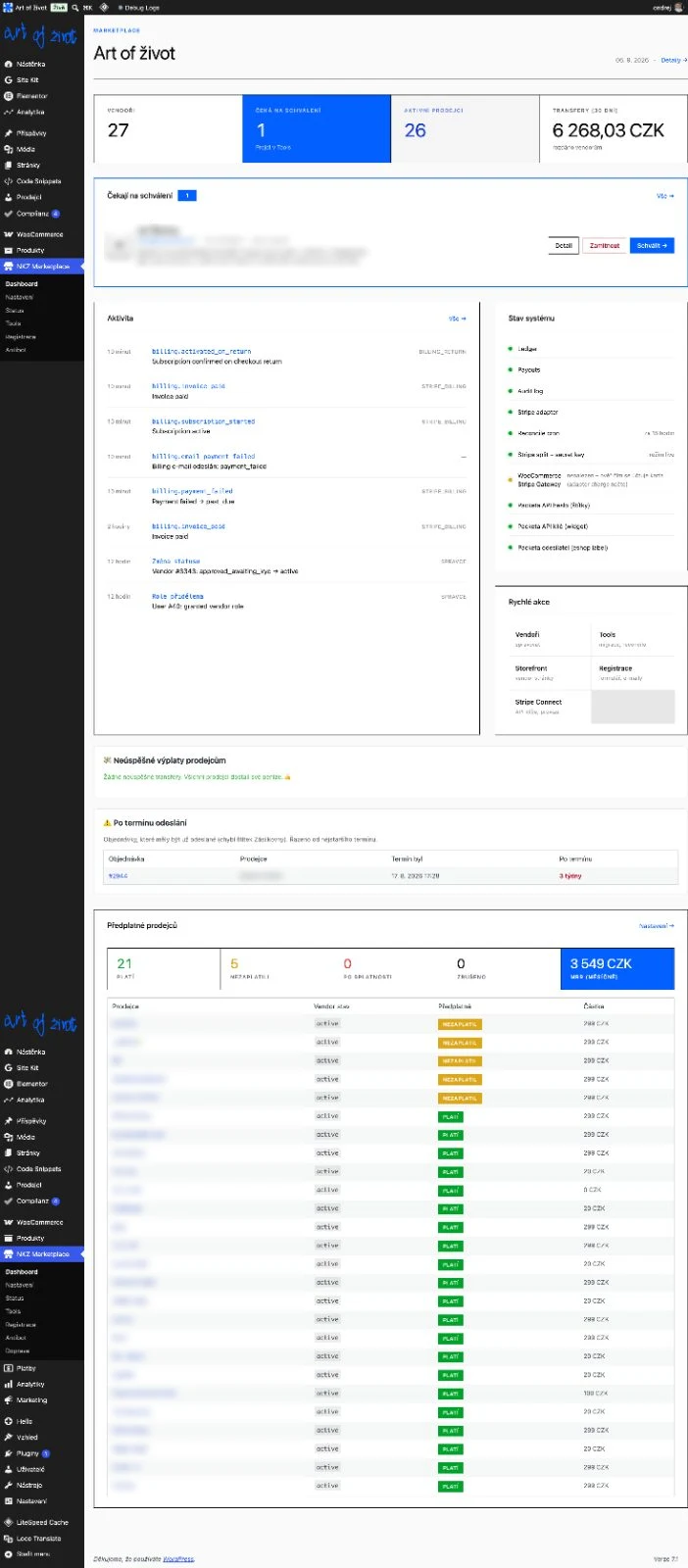
A custom part on top of the platform. A marketplace is a different product from a shop: seller approval, split payments, a dashboard for each of them and a record of payouts. At Art of Život WooCommerce stayed and a custom part was built above it. No migration was needed.
In this overview, a custom part comes out in only one of the four examples. For a specific e-shop, what decides it is its platform, its data and its sales rules. What the platform can still carry is covered in When WooCommerce is enough and when it is not; this article is about when a rebuild is worth the investment.
How to decide without guessing
Sit down with those five questions and count the hours of manual work per month. Multiply them by the hourly cost of the person doing it. Add the running costs of the solution and assume manual work will not disappear entirely. If the annual figure still clearly exceeds the price of the changes, you have enough to decide.
If you are not sure, the calculator gives an indicative scope and we can go through the rest in a consultation.