

It is not about the number of products
The most common myth is that WooCommerce cannot handle a large catalogue. WooCommerce can handle even an extensive catalogue. The result depends on the data model, variants, filters, hosting and plugins. What brings it down is a badly built catalogue: thousands of variants crammed into one product, filters that scan the whole database on every load, or twenty plugins each adding a query of its own.
The deciding question is not how many, but how complex the rules of your sale are. An ordinary purchase is simple: choose, pay, receive. The moment approvals, per-customer pricing or multiple sellers enter the picture, the platform starts to bend.
What WooCommerce usually handles
- Ordinary retail, even with an extensive catalogue, as long as it is well built.
- Variants, as long as they stay at a sane count and are not generated combinatorially.
- Selling services, bookings and vouchers through an add-on that uses the existing basket.
- Connections to invoicing, stock and couriers; ready-made solutions exist for these.
At Screeno, bookings, workshops and gift vouchers all went through WooCommerce. The studio already used it to sell t-shirts, so orders and documents stayed together. That is the typical case where the platform should not be abandoned, only extended.
Where it starts to hurt
Multiple sellers on one shop
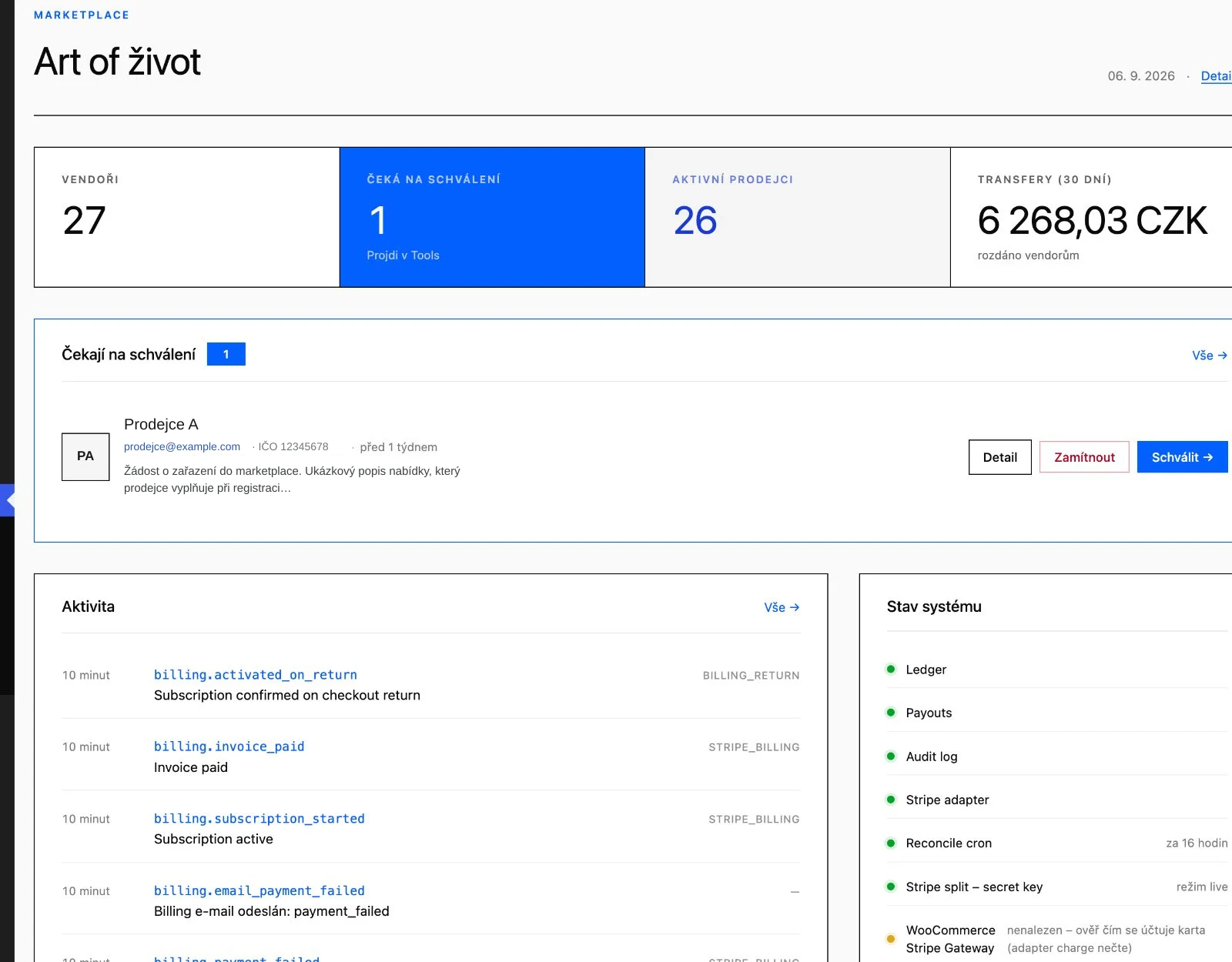
A marketplace is a different product from a shop. It needs seller approval, split payments, a dashboard for each seller and a record of who was paid what. Ready-made plugins do this up to a point and then stop. At Art of Život we built the marketplace on top of WooCommerce, but the custom part is most of the work.
Per-customer pricing
Wholesale with individual price lists, quantity tiers and order approval is exactly where WooCommerce is bent with plugins as far as it goes, and the rest is made up by hand. That manual work is the real cost; it just is not on an invoice.
Bundles: a common misconception
There are ready-made extensions for some types of bundles and shared stock. Before a rebuild, check whether they cover your particular rules. If someone proposes a rebuild over bundles straight away, ask why. The boundary tends to be elsewhere: a configurator where options depend on each other, where the price only emerges from the combination, or where the bundle is made to order and stock is written off after production.

How to decide
Count the hours someone spends each month making up for what the system cannot do. Retyping orders, working out commissions by hand, checking nothing was lost. If that runs to tens of hours, development has something to repay. If it is two hours, leave it alone.
And there is the option people forget: keep the platform and add only the one missing part. It is almost always cheaper than migrating and it solves the actual problem. We write about it in Grow the e-shop you have, or build a new one? and it is the essence of our e-commerce work.